Most kitchens do not run out of space all at once. They become frustrating little by little, as lids slide behind pots, baking trays lean into cereal boxes and the cabinet under the sink turns into a dark cave of half-used cleaners. The good news is that you can customize kitchen cabinets for better storage without replacing every cabinet or starting a full remodel.
The best customize kitchen cabinets storage upgrades are not the fanciest ones. They are the ones that match how you cook, clean and move through the room. A family that batch-cooks needs different storage from someone who uses the kitchen mostly for coffee, snacks and quick dinners. Before you buy organizers or order custom inserts, build a plan around your daily habits.
Start With a Cabinet Storage Audit
Open every customize kitchen cabinets and look at what is actually happening inside. You are not just checking whether the space is full. You are looking for friction: items you avoid using because they are hard to reach, shelves that waste vertical space, stacks that fall over and cabinets that hold things far away from where you need them.
A useful audit takes less than an hour. Empty one cabinet at a time, group similar items together and remove anything that is broken, duplicated or rarely used. Then ask whether each item is stored near the task it supports. Pots belong near the cooktop, mugs near the coffee station and food containers near the area where you pack leftovers.
If your customize kitchen cabinets updates are part of a wider refresh, it helps to connect storage choices with layout, lighting and finish decisions. Kitchen Campaign’s guide to kitchen remodeling ideas that add function and lasting style is a helpful companion when you want cabinet upgrades to fit a larger design plan.
Divide Your Cabinets Into Work Zones
A customize kitchen cabinets is easier to organize when each cabinet has a job. Instead of spreading everyday items wherever they fit, create simple zones around how you use the room. This makes it easier to decide which cabinets need pull-out shelves, dividers, risers or deeper customization.
| Kitchen zone | Best cabinet location | Smart cabinet customization | What it solves |
|---|---|---|---|
| Cooking zone | Near stove or cooktop | Roll-out trays, pan dividers, lid racks | Heavy cookware and messy stacks |
| Prep zone | Near main counter | Drawer dividers, cutting board slots, utensil inserts | Cluttered tools and hard-to-find prep items |
| Food storage zone | Pantry cabinet or tall cabinet | Pull-out baskets, shelf risers, labeled bins | Hidden groceries and expired food |
| Cleaning zone | Under sink or nearby base cabinet | U-shaped pull-outs, door-mounted racks, removable bins | Awkward plumbing space and cleaning clutter |
| Serving zone | Near dining area or island | Adjustable shelves, plate racks, glassware risers | Crowded dishware and wasted height |
This zoning approach keeps storage practical. It also prevents one of the most common cabinet mistakes: making every cabinet look organized but not making the customize kitchen cabinets easier to use.
Customize Lower Cabinets First
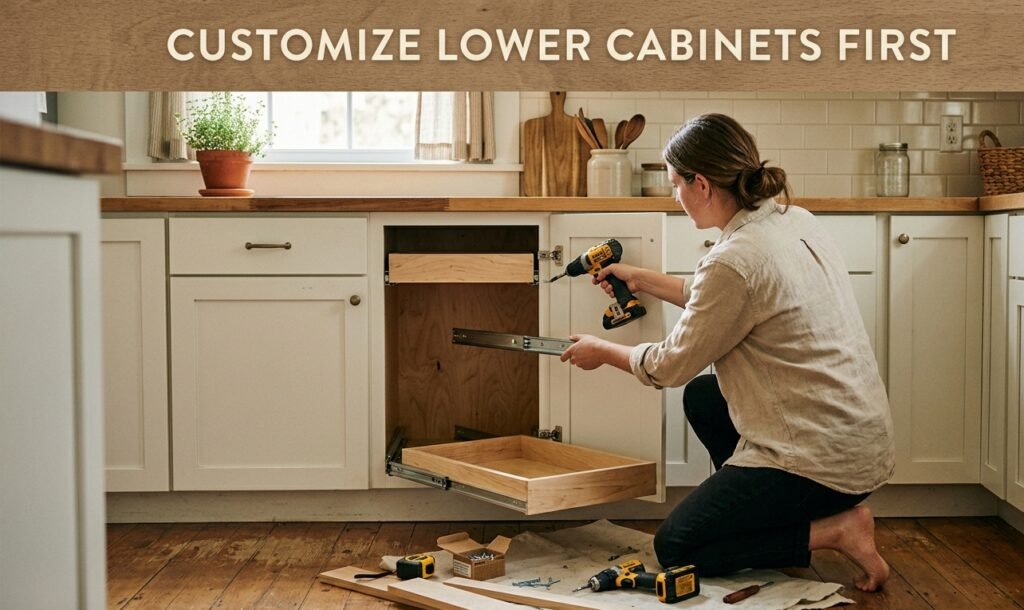
Lower cabinets usually need the most help because they are deep, low and difficult to see into. A standard base cabinet can hold plenty, but when it has fixed shelves, the back half often becomes storage you rarely access.
Replace fixed shelves with roll-out trays
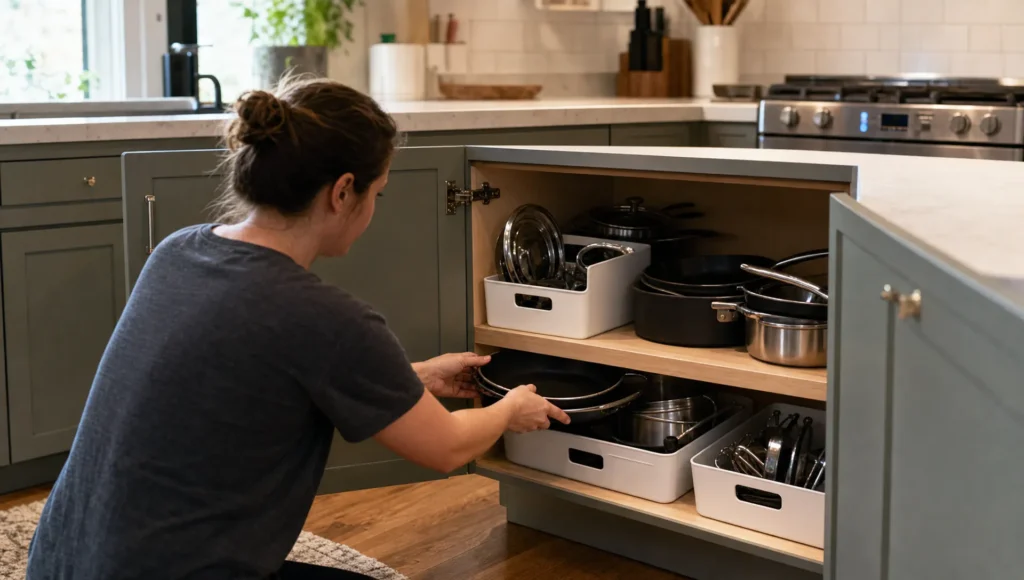
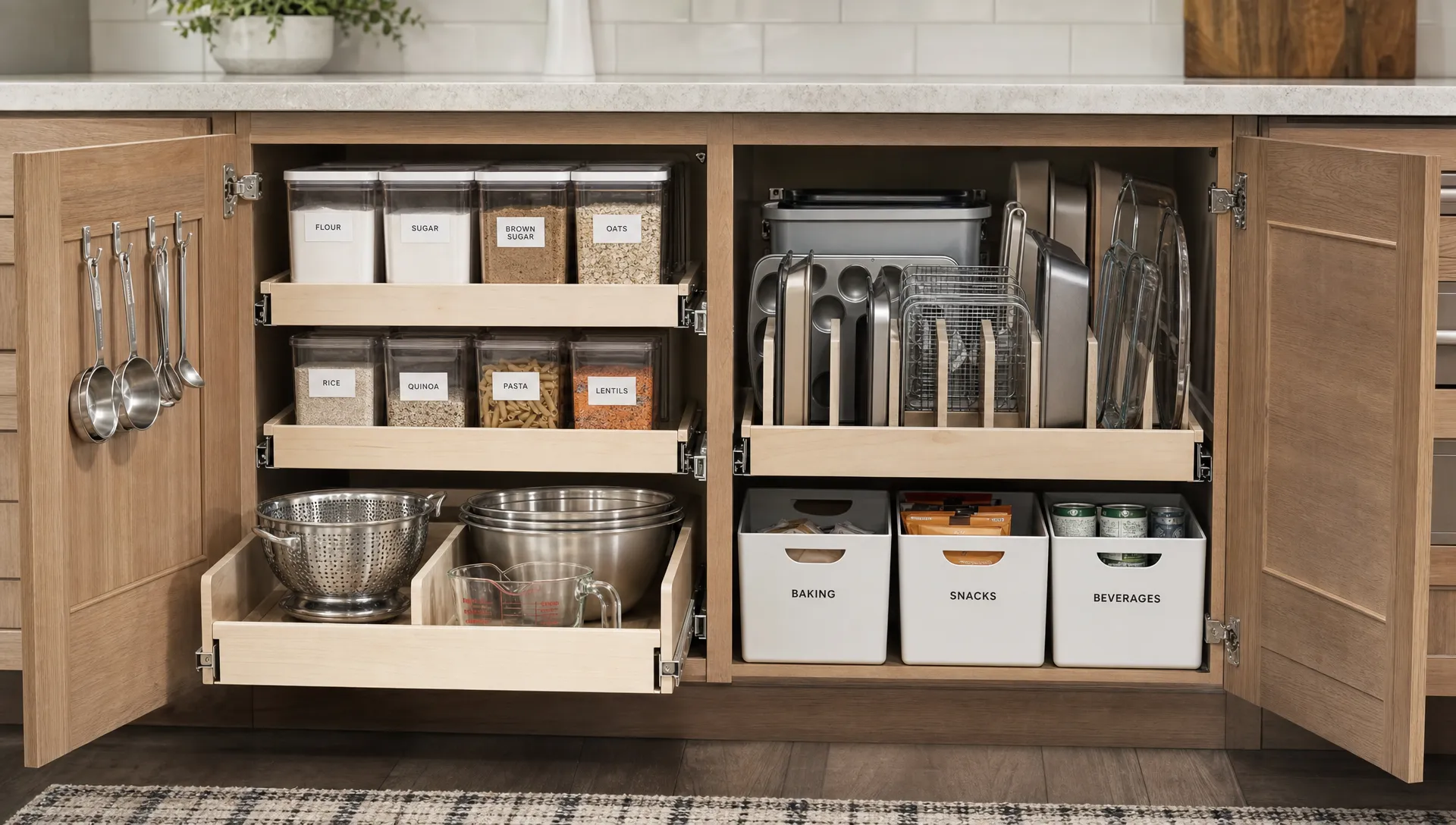
Roll-out trays are one of the most useful ways to customize kitchen cabinets for storage because they bring the contents to you. They work especially well for pots, small appliances, mixing bowls, food storage containers and pantry goods.
Choose shallow roll-outs for items you want to see at a glance and deeper ones for bulkier pieces. Before installing, measure the inside width, depth and height of the cabinet. Also check the door hinges, center stiles and any pipes or outlets that may affect clearance.
Use vertical dividers for trays and pans
Baking sheets, cutting boards, cooling racks and muffin tins are difficult to stack neatly. Vertical dividers solve that problem by turning a messy pile into a row of easy-to-grab items. They can be installed in a narrow base cabinet, above the oven or inside a pantry cabinet.
This is a simple upgrade with a big payoff. It keeps flat items from sliding around and makes better use of tall, narrow spaces that might otherwise become cluttered.
Add lid storage instead of stacking everything
Pot lids cause chaos because they are awkward, noisy and rarely stack well. You can store them vertically in a divider, hang them on a cabinet door rack or place them in a dedicated pull-out. The best choice depends on your cookware set and whether your cabinet doors have enough interior clearance.
For everyday cooking, keep lids close to the pots they match. If you have specialty cookware you use only a few times a year, move it to a higher or less central cabinet so the daily cooking zone stays clear.
Make Upper Cabinets Work Harder
Upper cabinets often waste vertical space. A customize kitchen cabinets tall shelf with short mugs or bowls leaves empty air above everything. Customizing upper cabinets is usually about adjusting shelf heights and adding layers without making the cabinet feel cramped.
Adjustable shelves are the first place to look. If your cabinet has peg holes, move shelves to match what you actually store. Place plates, bowls and glassware in stacks that are easy to lift without overloading the shelf. If shelves are fixed, shelf risers can create a second level for mugs, small plates or pantry jars.
For cabinets above eye level, avoid storing fragile daily items at the back. Use those spots for lightweight serving pieces, seasonal dishes or backup supplies. If you have deep upper customize kitchen cabinets and struggle to reach the back, shallow bins with handles can help you pull items forward without climbing onto a chair.
Pull-down shelves can also work well in taller wall cabinets, especially for homeowners who want easier access without changing the cabinet exterior. They cost more than basic risers, but they can make high storage usable again.
Turn a Pantry Cabinet Into a System
A pantry cabinet becomes easier to customize kitchen cabinets manage when it has layers, labels and clear categories. Without structure, groceries disappear behind other groceries and you end up buying duplicates.
Start by grouping food based on how you cook: breakfast, baking, snacks, dinner staples, oils and condiments. Then customize the cabinet around those groups. Pull-out baskets work well for bags and packets, clear bins help with snacks and shelf risers make cans or jars visible.
Door-mounted racks are useful for lighter items such as spices, wraps, packets or small bottles. Do not overload cabinet doors with heavy jars unless the hinges and door construction can support the weight. A door rack should make access easier, not strain the cabinet.
For tall pantry cabinets, use the most reachable shelves for everyday ingredients. Store occasional items at the top and heavier goods lower down. The goal is not just neatness. The goal is to see what you own before you shop.
Improve Drawers Before Adding More Cabinets
Drawers are often easier to customize than customize kitchen cabinets, and a well-planned drawer can replace a cluttered shelf. If your kitchen has deep drawers, use them for dishes, pots, mixing bowls or food containers. With the right inserts, deep drawers can hold far more than expected while keeping everything visible.
Drawer dividers are essential for utensils, prep tools and small gadgets. Choose adjustable dividers if your collection changes often. For plates or bowls, peg systems keep stacks from shifting when the drawer opens and closes. For spices, an angled insert makes labels easier to read than a crowded shelf.
Knife storage deserves special attention. A drawer knife block keeps blades protected and counters clear. It can also be safer than storing loose knives in a utensil drawer. If you prefer a countertop block, use the drawer for cutting boards, measuring tools or prep accessories instead.
Customize Awkward Cabinet Areas
Every customize kitchen cabinets has problem cabinets. These spaces are not useless, but they do need the right treatment.
The under-sink cabinet is one of the hardest to organize because plumbing interrupts the space. A customize kitchen cabinets U-shaped pull-out, two small sliding bins or a removable caddy can make cleaning supplies easier to reach. Keep only kitchen-related cleaners here and avoid storing items that could be damaged by leaks.
Corner cabinets are another challenge. Lazy Susans, kidney-shaped pull-outs and blind-corner organizers can all help, but the best option depends on the cabinet type. If you are not ready for a built-in mechanism, use large bins to group items so you can pull out the whole category at once.
The cabinet above the refrigerator is often too high and deep for daily items. Use it for lightweight, low-use pieces such as party trays, picnic supplies or seasonal serving dishes. Place items in labeled bins so the cabinet does not become a forgotten storage zone.
Toe-kick drawers can add hidden storage below base cabinets, but they usually require more advanced carpentry. They are best for flat, occasional-use items such as placemats, baking sheets or extra linens.
Choose Upgrades Based on Budget and Skill Level
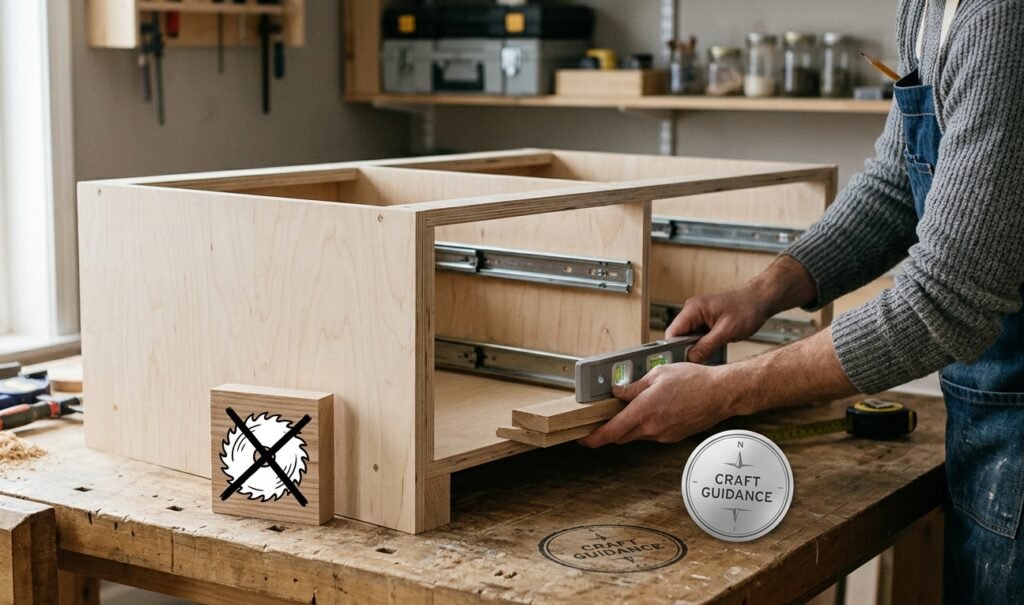
Not every customization needs a contractor. Many cabinet storage improvements can be done with off-the-shelf inserts, careful measuring and basic tools. Others involve cutting cabinet parts, moving plumbing or changing doors and drawers, which may call for professional help.
| Upgrade | DIY friendly? | Best use | Planning note |
|---|---|---|---|
| Shelf risers | Yes | Upper cabinets, mugs, small plates | Measure shelf height before buying |
| Clear bins | Yes | Pantry cabinets, snacks, packets | Choose bins that pull out easily |
| Drawer dividers | Yes | Utensils, tools, food containers | Adjustable dividers give more flexibility |
| Roll-out trays | Usually | Lower cabinets, pots, pantry goods | Check door and hinge clearance |
| Vertical dividers | Usually | Baking sheets, trays, cutting boards | Works best in narrow or tall spaces |
| Pull-down shelves | Sometimes | High upper cabinets | Installation accuracy matters |
| Toe-kick drawers | Usually no | Hidden flat storage | Often needs custom carpentry |
If the project involves altering cabinet boxes, moving plumbing or hiring a carpenter, compare labor expectations before committing. Homeowners in the UK can use HaMuch to see how much tradespeople charge and get a clearer sense of whether a job is worth outsourcing or simplifying for DIY.
Make Storage Look Intentional
Better storage should not make your kitchen feel busy. The most successful cabinet customizations disappear into the design. Matching finishes, simple hardware and consistent interior organizers help the kitchen feel calm even when it stores a lot.
Hardware matters because it affects both comfort and appearance. Wide drawers often feel better with pulls, while smaller cabinet doors can look balanced with knobs. If you want a coordinated look without making every handle identical, Kitchen Campaign’s guide to mixing knobs and pulls on kitchen cabinets explains how to combine hardware in a way that still feels planned.
Interior finishes matter too. White or light-colored cabinet interiors can make deep storage easier to see. Wood inserts add warmth and can make open cabinets or glass-front cabinets feel more polished. Clear bins work well when you want visibility, while matching opaque bins can hide visual clutter in open shelving or glass-door areas.
If your cabinet boxes are functional but the exterior feels dated, you may not need full replacement. Refacing, repainting or updating hardware can work alongside interior storage upgrades. Just be sure to plan storage first, because new doors and drawer fronts should support how the cabinets will be used.
Avoid Common Cabinet Customization Mistakes
customize kitchen cabinets organizers can create new problems when they are chosen too quickly. The goal is not to fill every inch with accessories. The goal is to make each item easier to store, reach and return.
Avoid these common mistakes:
- Buying organizers before measuring cabinet interiors, doors and hinge clearances
- Adding too many small bins, which can make cabinets harder to maintain
- Storing heavy items too high or too far from where they are used
- Choosing trendy inserts that do not match your cooking habits
- Forgetting to leave room for future groceries, dishes or appliances
- Installing permanent solutions before testing a temporary layout
A simple test can save money: organize the cabinet with temporary bins or cardboard dividers for a week. If the layout feels natural, invest in better inserts. If you keep fighting the system, adjust before installing anything permanent.
Keep Customized Cabinets Easy to Maintain
A customized cabinet only works if it stays easy to reset. If every item has a clear home, cleanup becomes faster and the kitchen stays organized with less effort.
Plan for maintenance from the beginning. Use wipeable liners in messy areas, especially under the sink and inside pantry cabinets. Choose removable bins for snacks, oils and cleaning supplies so you can clean spills quickly. In drawers, avoid inserts with too many tiny compartments unless you truly need them.
Clean cabinet interiors during seasonal resets and check whether your storage still matches your habits. Families change, cooking routines change and appliances come and go. A cabinet system should be flexible enough to adapt. For safe cleaning methods that protect finishes, use Kitchen Campaign’s guide on how to clean kitchen cabinets before scrubbing painted, wood or laminate surfaces.
Create Cabinets That Work the Way You Live
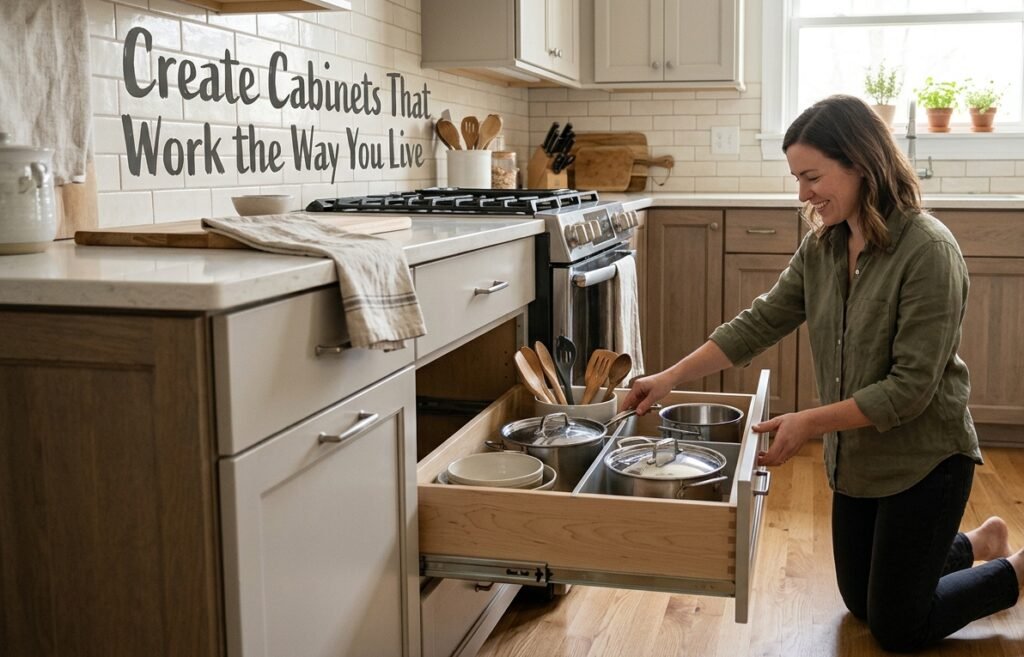
You do not need a bigger kitchen to get better storage. You need cabinets that match your routines, make everyday items easier to reach and keep clutter from drifting back onto the counters.
Start with one problem cabinet, measure it carefully and choose a customization that solves a real issue. Once that cabinet works better, move to the next. Small, thoughtful upgrades can change the way your whole kitchen feels, one shelf, drawer and pull-out at a time.
Most importantly, good kitchen storage should make your daily routine easier. When everything has a logical place, you spend less time searching through crowded cabinets and more time enjoying your kitchen. By carefully planning your layout and choosing the right ways to customize kitchen cabinets, you can turn unused or difficult spaces into efficient storage while keeping your kitchen organized, comfortable, and functional for years to come.
Conclusion
You do not need to replace your entire kitchen to create better storage. The key is to customize kitchen cabinets around the way you cook, clean, and use your space every day. Start by identifying problem areas, decluttering unused items, and choosing practical upgrades such as roll-out trays, drawer dividers, shelf risers, and pantry organizers.
Even small changes can make cabinets easier to access and keep countertops less cluttered. Whether you choose simple DIY organizers or professional customization, focus on solutions that improve everyday convenience. When storage is designed around your routine, your kitchen can become more organized, functional, and enjoyable without requiring a complete remodel.
FAQ’S…
What is the best way to customize kitchen cabinets for more storage?
Start with lower cabinets, drawers and pantry cabinets because they usually create the most daily frustration. Roll-out trays, vertical dividers, drawer inserts and shelf risers often provide the biggest improvement without replacing the cabinets.
How Much Do 12×12 Kitchen Cabinets Cost?
The cost of 12×12 kitchen cabinets depends on the material, design, finish, hardware, and installation. Ready-made cabinets are generally more affordable, while customize kitchen cabinets can cost more because they are designed according to your exact space, storage needs, and preferred style.
How Can You Customize Kitchen Cabinets?
You can explore online kitchen cabinet designers and manufacturers to plan your cabinets remotely. Many providers allow you to select colors, materials, dimensions, and storage options. Before ordering customize kitchen cabinets, check measurements, material quality, design samples, pricing, delivery, and installation services.
What Kitchen Cabinet Sheet Designs Are Best for Custom Cabinets?
Popular kitchen cabinet sheet designs include wood grain, matte, glossy, solid colors, and modern textured finishes. When you customize kitchen cabinets, you can select a sheet design that matches your kitchen style while considering durability, moisture resistance, cleaning requirements, and overall budget.