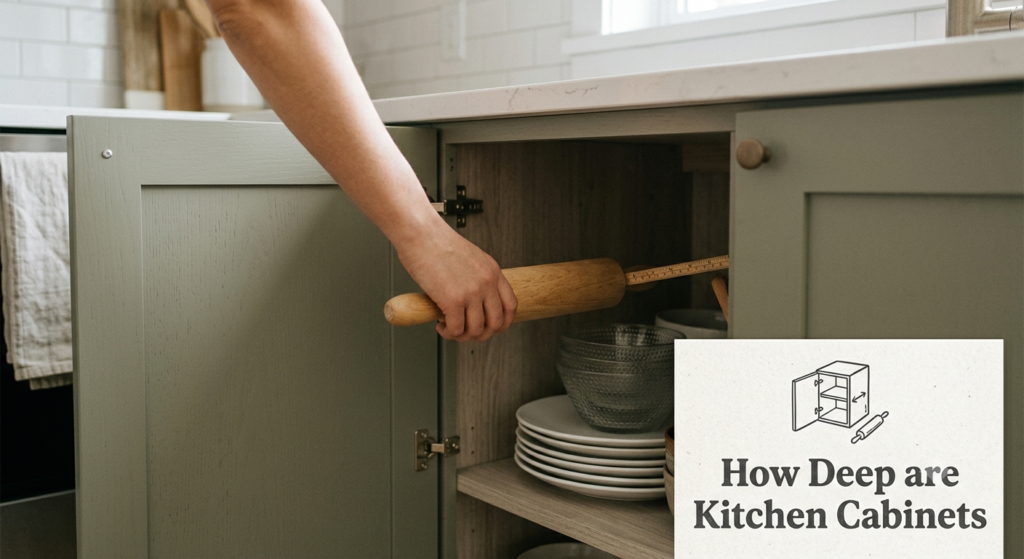
If you are planning a kitchen renovation, one of the most important questions you will face is: how deep are kitchen cabinets?
At first glance, cabinet depth may feel like a small technical detail. But in real kitchen design, it is one of the most important factors that affects everything—from storage space and cooking comfort to movement flow, appliance installation, and even how expensive your kitchen feels visually.
A beautifully designed kitchen can still feel “wrong” if cabinet depth is not planned properly.
In this complete guide, you will learn everything about how deep are kitchen cabinets, including industry standards in inches, millimeters, and centimeters, real-life design logic, comparisons, mistakes to avoid, and a full step-by-step planning system used by kitchen designers.
how deep are kitchen cabinets?
It sounds simple, but in real kitchen design, cabinet depth is one of the most critical decisions you will make. It affects:
- storage capacity
- cooking comfort
- kitchen movement flow
- appliance fitting
- countertop usability
- even how expensive your kitchen looks
Many homeowners focus only on color, style, or handles—but professionals always start with dimensions first, especially depth.
In this complete guide, you will learn everything about how deep are kitchen cabinets, including industry standards, regional measurements, real-life examples, design psychology, mistakes to avoid, and a step-by-step planning system.
What Does How Deep Are Kitchen Cabinets Actually Mean?
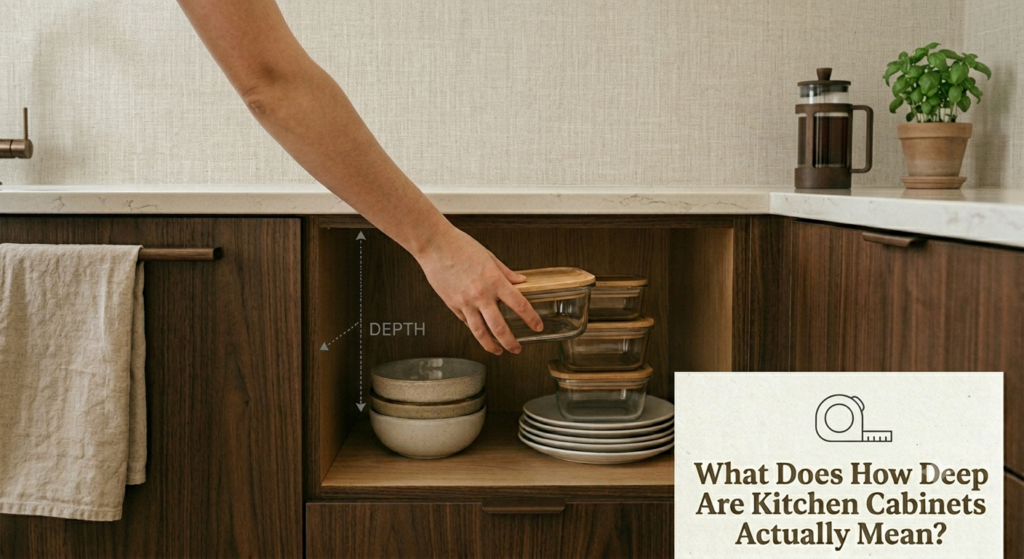
When people ask how deep are kitchen cabinets, they are referring to:
The distance from the back wall of the cabinet to the front edge of the door or frame.
This measurement defines how much usable space you actually get inside your kitchen storage.
To understand kitchen structure basics:
- Kitchen fundamentals overview
Kitchen cabinet dimensions include:
- Height (vertical space)
- Width (side space)
- Depth (front-to-back space)
Among these, depth is the most important for usability because it controls:
- how easily you can reach items
- how much storage you actually get
- how comfortable your kitchen feels
Standard Answer: How Deep Are Kitchen Cabinets in Inches
Let’s start with the most commonly used measurement system.
✔ Standard kitchen cabinet depths
- Base cabinets: 24 inches (61 cm)
- Wall cabinets: 12 inches (30 cm)
- Tall cabinets: 12–24 inches (30–61 cm)
Industry reference:
Why 24 inches is the industry standard

The 24-inch base cabinet depth is not random. It is based on:
- average human arm reach
- countertop usability
- appliance compatibility
- storage optimization
Simple explanation
If cabinets are:
- too shallow → storage feels useless
- too deep → items get lost
So 24 inches is the “perfect balance zone.”
Real-life example
A homeowner once upgraded from 18-inch to 24-inch cabinets.
Before:
- crowded countertops
- limited storage
- messy appearance
After:
- organized storage
- cleaner counters
- better cooking flow
They said:
“It felt like my kitchen doubled in space without changing the room size.”
How Deep Are Kitchen Cabinets in MM (Metric Standard System)
In modular kitchen design, millimeters are the global standard.
✔ Standard cabinet depths in mm
- Base cabinets: 600 mm
- Wall cabinets: 300 mm
- Tall cabinets: 300–600 mm
Conversion reference:
Why mm measurement is important
Understanding how deep are kitchen cabinets in mm is essential for:
- imported kitchens
- modular factory systems
- European design standards
- precise manufacturing
How Deep Are Kitchen Cabinets in CM
Centimeters are widely used in home construction planning.
Standard sizes in cm
- Base cabinets: 60 cm deep
- Wall cabinets: 30 cm deep
- Tall cabinets: 30–60 cm deep
Why cm matters for homeowners
Knowing standard kitchen cabinet sizes in cm helps you:
- visualize space better
- avoid contractor mistakes
- plan layouts faster
- compare international designs
Kitchen Wall Cabinet Depth (Upper Cabinets Explained Properly)
Upper cabinets are extremely important for kitchen aesthetics.
Standard wall cabinet depth
- 12 inches / 30 cm / 300 mm
Reference:
- Kitchen structure overview
Why wall cabinets are shallow
The kitchen cabinet depth upper is designed for:
- visibility
- safety
- comfort
- space balance
Common variations
- 12 inches → standard kitchens
- 15–18 inches → above stove or fridge
- 24 inches → luxury custom kitchens
Design mistake many people make
If upper cabinets are too deep:
- kitchen feels heavy
- counters feel tight
- head clearance becomes an issue
Tall Cabinets and Pantry Depth
Tall cabinets are used for maximum storage.
Standard tall cabinet depth
- 12 inches (narrow pantry)
- 24 inches (full storage)
Height range
- 84, 90, 96 inches
Why tall cabinets matter
They help you store:
- groceries
- cleaning supplies
- appliances
- bulk items
Full Kitchen Cabinet Size System (Complete Breakdown)
Base cabinets
- Depth: 24 inches / 60 cm / 600 mm
- Height: 34.5 inches / 87 cm
Wall cabinets
- Depth: 12 inches / 30 cm / 300 mm
- Height: 30–36 inches
Tall cabinets
- Depth: 12–24 inches
- Height: up to 96 inches
Real-Life Story: The Kitchen That Felt Too Small
A family built a modern kitchen but ignored cabinet depth.
They chose:
- deep upper cabinets
- narrow base cabinets
Result:
- kitchen felt crowded
- movement was restricted
- storage was inefficient
After redesigning with proper how deep are kitchen cabinets standards:
- space felt larger
- workflow improved
- cooking became easier
Their conclusion:
“We realized kitchen comfort is not about size—it’s about proportion.”
Step-by-Step Guide: How to Choose Cabinet Depth Like a Pro
Step 1: Measure kitchen layout
- wall length
- appliance position
- walkway clearance
Choose base cabinet depth
- 24 inches → standard homes
- 18 inches → small kitchens
- custom → luxury kitchens
Choose wall cabinet depth
- 12 inches → standard
- 15–18 inches → appliance areas
Choose tall cabinet depth
- 12 inches → pantry
- 24 inches → full storage
Check movement space
- minimum 36–48 inches walkway
Common Mistakes Homeowners Make

Avoid these:
- ignoring standard cabinet depth rules
- mixing metric and imperial incorrectly
- choosing oversized cabinets for small kitchens
- not planning appliance clearance
- focusing only on looks
Pro Design Tips (Used by Kitchen Designers)
- Always start with base cabinet depth first
- Keep upper cabinets lighter visually
- Use 24-inch depth only where necessary
- Combine shallow + deep cabinets for balance
- Match depth with appliance layout
Pros and Cons of Standard Cabinet Depths
Pros
- industry standard
- ergonomic design
- widely available
- easy installation
Cons
- limited flexibility
- may need customization in small kitchens
- not ideal for irregular layouts
Why Understanding How Deep Are Kitchen Cabinets Is So Important

Because it directly affects:
- kitchen efficiency
- storage system
- cooking comfort
- resale value
- interior design balance
A wrong cabinet depth can ruin even an expensive kitchen.
Should You Buy Standard or Custom Cabinet Depth?
Choose standard if:
- you want affordability
- you want easy installation
- your kitchen is normal size
Choose custom if:
- you have a small kitchen
- you want luxury design
- you need special storage
Final Conclusion
Understanding how deep are kitchen cabinets is one of the most important parts of kitchen planning.
The industry standard exists for a reason:
- 24 inches / 600 mm for base cabinets
- 12 inches / 300 mm for wall cabinets
These measurements are based on real human behavior, ergonomics, and decades of design experience—not random rules.
When you choose the right kitchen cabinet depth, you don’t just build a kitchen—you create a space that feels easier, cleaner, and more comfortable every single day.
A well-designed kitchen is not about size or luxury—it is about smart structure, and cabinet depth is the foundation of that structure.
FAQ’S…
How deep are kitchen cabinets normally?
Standard kitchen base cabinets are typically 24 inches deep, while wall cabinets are usually 12 inches deep. These dimensions provide a balance between storage capacity, accessibility, and efficient use of kitchen space.
What is wall cabinet depth?
Most kitchen wall cabinets are 12 inches deep, though some range from 10 to 15 inches depending on design needs. This depth allows easy access while leaving enough clearance above countertops.
Can cabinet depth be customized?
Yes, cabinet depth can be customized to fit unique layouts and storage requirements. Custom cabinets are often made deeper or shallower than standard sizes, though customization typically increases manufacturing and installation costs.
What is the best depth for small kitchens?
For small kitchens, standard 24-inch base cabinets usually work best. However, shallower cabinets between 18 and 21 inches can help improve traffic flow and make tight spaces feel more open.
Why is 24 inches standard?
The 24-inch depth became the industry standard because it offers sufficient storage while maintaining comfortable workspace and movement. It also fits most kitchen appliances and countertop designs efficiently.
What colors make a kitchen look expensive?
Warm whites, soft greige, natural wood tones, deep navy, sage green, and charcoal gray can make a kitchen look more luxurious. Pairing these colors with quality lighting and premium hardware enhances the upscale appearance.